


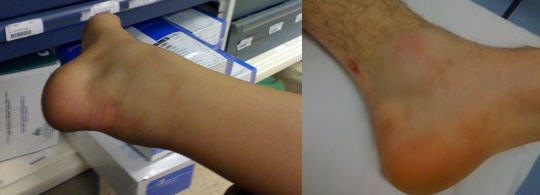
Not exactly surprising considering the explosion in the growth of the sport, but a recent study found a 63% increase in the number of rock climbing-related injuries treated in emergency departments between 1990 and 2007:
The study, published in the online issue of the American Journal of Preventive Medicine, found that over 40,000 patients were treated in U.S. emergency departments for rock climbing-related injuries between 1990 and 2007. The most common types of rock climbing-related injuries were fractures (29 percent) and sprains and strains (29 percent). Lower extremities were the most common region of the body to be injured (46 percent) while the ankle was the most common individual body part to be injured (19 percent). The study also found that women accounted for more than 28 percent of the injuries, a higher proportion than found in previous rock climbing studies.
Falls were the primary mechanism for injury with over three-quarters of the injuries occurring as the result of a fall. The severity of fall-related injuries correlated with the height of the fall. Patients who were injured after falling from a height over 20 feet were 10 times more likely to be hospitalized than patients who were injured falling from 20 feet or lower.
“We found that the climbers who fell from heights higher than 20 feet accounted for 70 percent of the patients there were hospitalized for a rock climbing-related injury,” explained study author Lara McKenzie, PhD, principal investigator at the Center for Injury Research and Policy at Nationwide Children’s Hospital and faculty member of The Ohio State University College of Medicine. “This trend, combined with the fact that rock climbers have a higher hospitalization rate than other sports and recreational injuries, demonstrates the need to increase injury prevention efforts for climbers.”
Given the nature of the sport it’s obvious that lower extremities injuries would make up the bulk of injuries requiring a trip to the hospital. However, women accounting for 28% of the injuries is a bit intriguing. Does this disproportionate level of injury have to do with (usually) more experienced male partners somehow abdicating in their safety duties when climbing with (usually) less experienced female climbers or is it something else? Given my track record of injuring a certain female climbing partner of mine I’m not sure I’m qualified to comment.
The other part I found interesting was the assertion that climbers are hospitalized more often than other sports and that 70% of patients hospitalized fell from greater than 20 feet. If you think about it, a 20 foot fall is not that run out at all!
The moral of the story: don’t become a statistic, be safe out there!
Update: You can read the full study here


The language describing fall height is weird. I’m inclined to think they meant hitting the ground from 20 feet or more, but I don’t know how they accounted for falls on a rope. And hospitalization is different than treat and discharge.
Also, Narc, are you saying that 28% seems disproportionately high?
loading...
For some reason I assumed that women account for less than 28% of the climbing population which would make it disproportionately high. The more I think about it the more I think I could be off base in that assumption though. That would make men disproportionate in their level of injury which would be easier to explain given that men are generally less afraid to take risks while climbing.
The language about the fall height is a bit ambiguous. I tried finding more information about the study itself but was unable to do so.
loading...
Yeah, I think your assertion that women are injured by men that are somehow responsible for their safety is a bit offensive. It sounds like somebody asserting that women have more car accidents because men don’t teach them how to drive correctly. 😛
In climbing, you are always responsible for your own safety, regardless of gender.
That, and I think 28% female is a reasonable, not disproportionate, number.
loading...
Hey Kate,
That paragraph is one I would like to have back the more I thought about it, but since it was already out there I didn’t think it was ok to just remove it.
loading...
Great link and summary. 20 feet for a roped fall is pretty substantial, even on a steep wall. There’s more opportunity for gear to fail or for the climber to land poorly or out of control, especially on moderate terrain. It would be also interesting to know the skill levels of these injured climbers. Acute injury as opposed to overuse injury may well point to the lower end of the spectrum grade-wise.
loading...
Again making an assumption, but one would think that most injuries requiring a visit to the hospital are more of the acute variety and not from overuse.
20 feet is a substantial fall but it is one faced (but not experienced) many times by most climbers without incident. In the instance of Mrs. Narc’s ankle breaking fall it was the acute angle of a short fall combined with heinous rope drag that caused her injury.
loading...
I feel that with the surge in the popularity of climbing over the years, better training is important.
Some people are fortunate to have/find good mentors, but as the number of new climbers increases, I think the demand for experienced climbers willing to take people under their wing has outgrown the supply. While there will always be people out there that teach themselves to climb safely, I think more/better education will be needed to keep the injury rate down. Especially when people want to trad climb.
loading...
This all seems pretty obvious to me. I was going to comment more here, but things got a bit long so I just put it up on my blog.
loading...
You can read the full study here:
http://climbingnarc.com/downloads/Injuries.pdf
loading...
I read through the article and I’m still not impressed. At least there is some statistical analysis and confidence intervals are included, but the conclusion says it best: “This report confirms much of the existing research on medically-attended rock climbing–related injuries…”
Nothing surprising was revealed and the most interesting questions haven’t been answered yet.
loading...
I think this information is interesting but slightly useless. I understand Sean’s argument for better training, however, a few statistics are missing. What is the increase of the climbing population since 1990? Was it 50%, 100%, or more. It could be that the sport of climbing is getting safer but there are a huge number of people participating in the sport. The other deal is that these statistics do not differentiate between climbers getting injured and people getting injured climbing. Gym climbers vs. outside climbers, etc.
loading...