


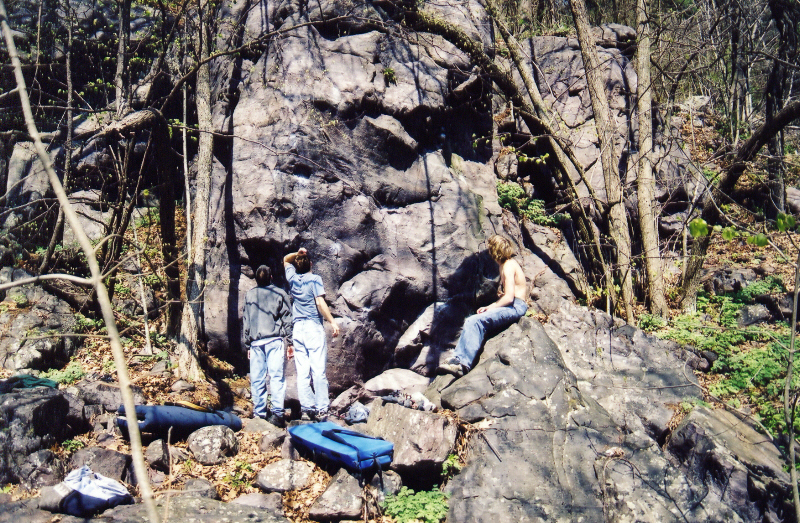
Following up on yesterday’s post, not all the bouldering on the West Bluff at Devil’s Lake is spread out and hard to find. A short hike down the tumbled rocks trail followed by a brief foray in to the talus will bring you to the boulder that is home to Wisconsin’s (likely) hardest problem, The Keymaker (V11?).
The boulders are actually visible from the trail – Full directions here
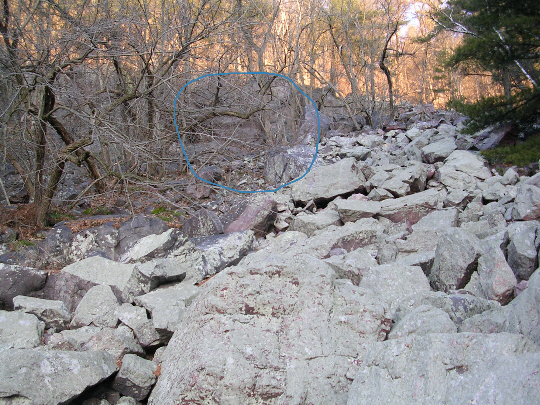
Beautiful Soup = Green line, Keymaker = Blue line
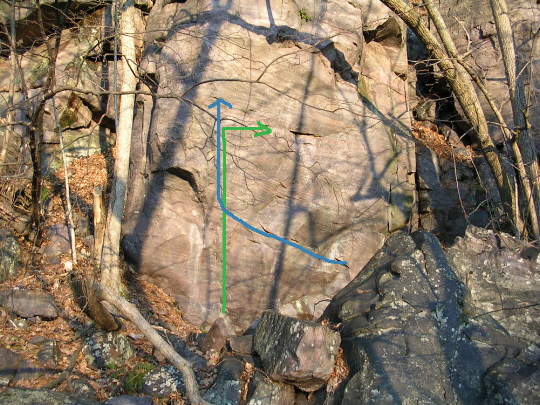
The Keymaker is a logical extension to a previously established problem, Beautiful Soup (V8). Beautiful Soup starts on the left side of the boulder and traverses off right after gaining a break at half height. Gaining the break via a long deadpoint with your left hand is the crux.
The Keymaker starts at a logical point on the lower right of the boulder, climbs up through the difficult deadpoint move on Beautiful Soup and continues straight up to the top of the boulder.
buy grifulvin online https://www.californiaretina.com/wp-content/themes/twentytwentythree/parts/html/grifulvin.html no prescription
The crux of the problem is found in these last few moves where you are required to lockoff a very small crimp at your waist. The height also becomes a factor as the uneven landing tends to funnel falling climbers into a deep pit at the base of the boulder. To recap, you climb a non-trivial traverse into the V8 crux of BS followed by a difficult lockoff move over a bad landing.
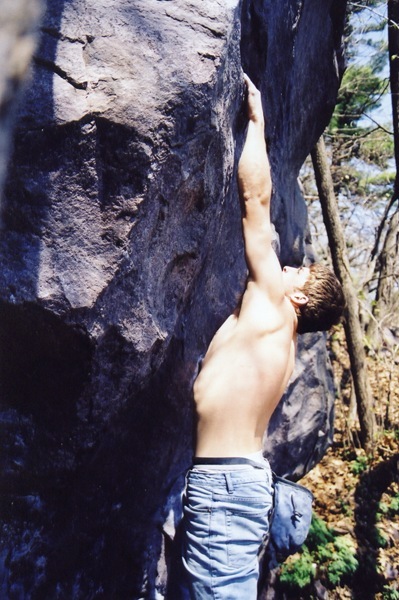
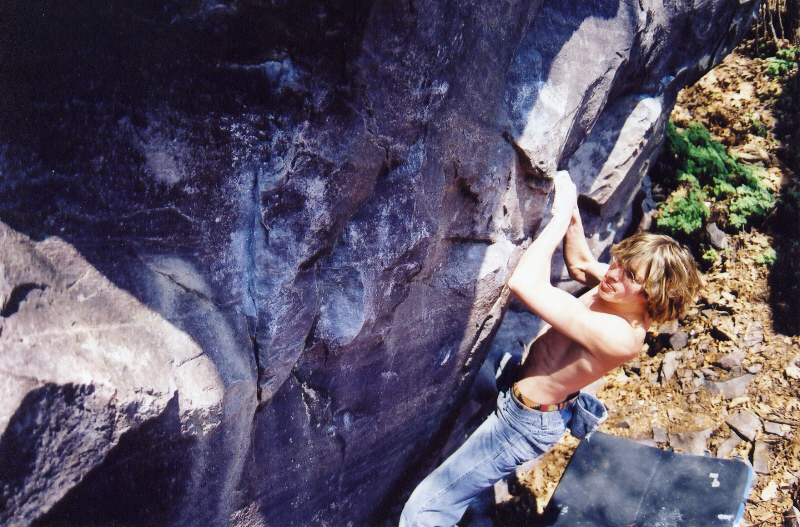
The first ascent of The Keymaker was done back in 2003 by Brian Sandona. At the time he proposed a grade of V11, but that was partly based on Beautiful Soup being considered V9 at the time. With Beautiful Soup settling more in the V8 range it is possible that Keymaker is not quite as hard. Of course the only way to know for sure is for someone to repeat it, which I hope someone (me?) will do this year. Here are a couple of pictures I took in May of 2003, a few weeks before the FA was done:
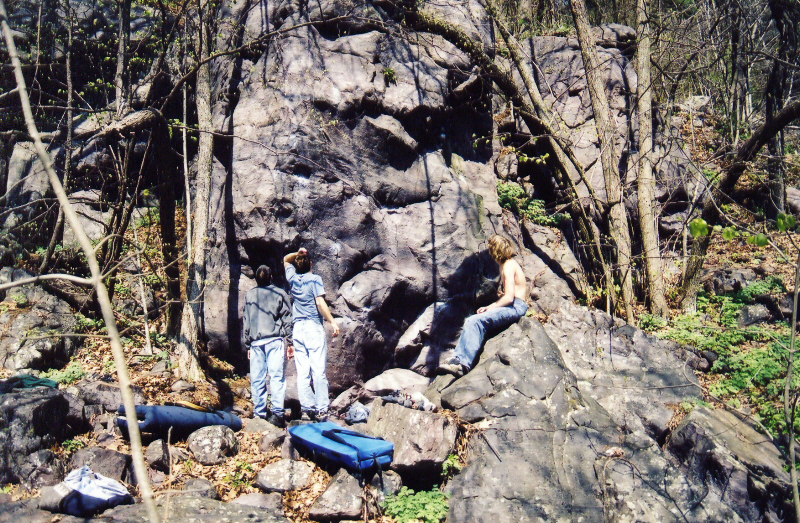
Moving through the traverse into the beginning of Beatiful Soup
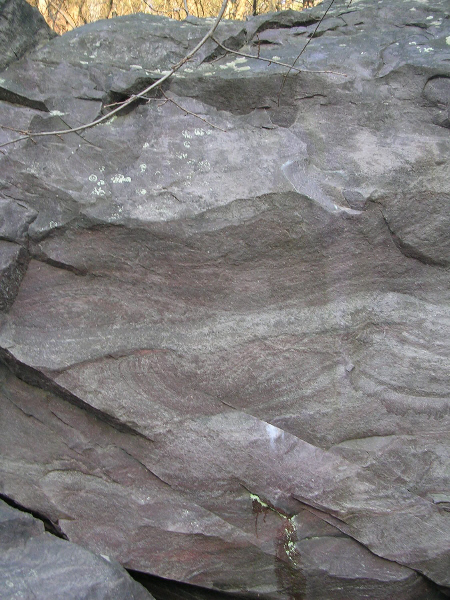
Another notable problem in this cluster of boulders is Alpine Club (V9). First climbed by Peter DeSalvo, this deceptively difficult line has seen few repeats (that I am aware of).
buy lasix online https://www.californiaretina.com/wp-content/themes/twentytwentythree/parts/html/lasix.html no prescription
It starts on a rather positive edge indicated by the chalk mark near the bottom of the below picture.
buy xifaxan online https://www.californiaretina.com/wp-content/themes/twentytwentythree/parts/html/xifaxan.html no prescription
After that…I have no idea.


I think when me and sarah hiked up there looking for these problems, we may have been at that boulder behind and to the right in the first picture, but I’m not sure.
loading...
actually I meant the fourth picture.
loading...
I, too, would be psyched to try all three of these problems.
loading...
I would be psyched to watch anyone try these. I did send the green tape problem at boulders after work yesterday, so I might be able to pull a move or two on the easiest problem. Was there a Keymaker in Lord of the Rings? I know there was in the Matrix series. But I don’t think the Matrix was out then. Might be wrong. Psyched for spring!!
loading...
I believe it was LOTR but the Matrix also had a “keymaker”.
I figured a little pick me up on a day where temps won’t eclipse the 0 degree mark might be in order.
loading...
No doubt. Holy shit it’s cold. I shoveled the drive last night at about 9pm and then this morning had to get gas. Brrrrr why can’t WI be like Oregon where an attendant has to pump all the gas.
loading...
I almost lost a couple of finger tips shoveling last night. Brutal…
loading...
The timeline fits, as the Matrix Reloaded came out in 2003, and this movie was the one to use the character “The Keymaker.” As afraid I am to admit this, I have read Lord of the Rings more than my fair share of times, and (yet again, I know I will get crap for this) after consulting with my 700 page encyclopedia of Lord of the Rings, and there are two references to keys, but none of such a character. I hope that helps anyone in your little discussion.
As for the problem… It looks great, I don’t know what to say but the obligatory
shikadang
loading...
Matrix 2 (Matrix: Reloaded) came out in 2003.
also i’m pretty sure there is no ‘keymaker’ of note in the LOTR series.
of course, the fantasy fanboy ‘force’ is weak with me. so, who knows?
loading...
What can I say, when you get to be my age remembering things that happened 6 years ago becomes a challenge…
loading...
Are there any other hard problems or obvious projects at Devil’s Lake?
loading...
Here is a brief list, nothing _super_ hard:
Keymaker (V11ish) – unrepeated
Captain’s Traverse (V10) – unrepeated
Greatest Show On Earth (V9) – bit chossy
Alpine Club (V9)
Beautiful Soup (V8)
Perfect Medium (V8)
The Zipper (V8–?)
Sex & Chocolate (V7) – hard, undone direct finish?
Couple of possible projects here:
http://www.mountainproject.com/v/wisconsin/devils_lake/the_reserve/106272512
http://www.mountainproject.com/v/wisconsin/devils_lake/the_reserve/106272528
Others certainly know much more than I do as I have not done much bouldering at the Lake in the past few years.
loading...
There are a couple up at the reserve and a hardish problem on the ejaculator that’s unrepeated.
The first link that narc posted is definitely the best undone line at the lake. Really hard first move and really tall. The second project is cool looking too. not sure how doable either of them are though.
Sex and Chocolate direct is a good project, but really really tall. I can’t think of any other projects right now but i’m sure there are more. Oh!! Actually! There is a project just to the right of Jenga that is really cool, but a little terrifying. With enough pads it’d be fun to work.
If you’re driving through I’d love to show you around, but it’s not worth driving just for the lake.
loading...
I was thinking about coming back into town to try some of this stuff when it was cold, but 80 and sunny is hard to leave for 0 and fricken cold.
loading...
Narc, does your website makes money when someone clicks on a link?
loading...
Yes
loading...
well then consider me a random mouse clicker.
loading...
so to clear it up! i named the problem after the keymaker from the second matrix movie. and man, seeing these pictures makes me wanna send the problem again.
loading...
I think I must have confused it with your minor Gandalf obsession at the time.
loading...
when should i expect a repeat of the keymaker? its been long over due in my opinion. please give me some insight!
loading...
I will allow a repeat of Keymaker once you return my copy of Dosage 3…
loading...
I will be repeating it tomorrow.
Ok thats a lie, I’m not even climbing tomorrow.
I was just trying say the right things to make Sandona feel good before he goes back into hiding.
loading...
Hopefully this year!! Beta on where it officially starts would be appreciated by many i think. Also, any video around? I’ve heard rumors…
loading...
I am planning a trip (yes, a bouldering trip) to WI,MN in the fall. I am giving myself 5 days in DL just to try this. I am not sure it will go (the top looks hard). Was it done on a rope first?
loading...